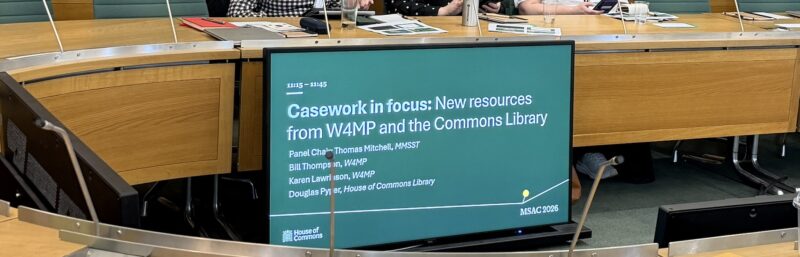
Caseworker Guides from w4mp and the Library

Standard
  • Has a constituent asked you for legal advice?
  • Is a local resident pushing for your MP to help them find housing?
  • Are you feeling pressure to give immigration advice?

The House of Commons Library and w4mp have published two new guides to casework to help you and your office handle questions, casework and conversations with constituents.

Find out what MPs offices can and can’t help with, explore casework resources, get information for constituents and discover how to navigate the grey areas.

You can find the Library Guide on their website, with further resources on Parlinet including a link to the w4mp guide.

POLITICO PRO UK: Parliamentary access

Standard

MPs and staffers are eligible to receive POLITICO Pro U.K. newsletters as part of the corporate license. Sign up here to start receiving:

  • U.K. Pro Energy & Climate
  • U.K. Pro Trade
  • U.K. Pro Technology
  • U.K. Pro Financial Services
  • The Ex Files (Everything Brexit related)

At no additional cost. Join hundreds of your colleagues who are already taking advantage of our exclusive intelligence. Sign up now.

esThe coverage provides:

  • Real-time alerts – Be the first to know about breaking policy developments, regulatory changes, amendments, consultations and political shifts, helping you to move quickly and confidently.
  • Regular briefings – Cut through the noise with concise round-ups summarising what’s happening, why it matters and what’s coming next, giving you clear, actionable insight.
  • Forward-looking intelligence – Stay ahead with insight on upcoming legislation, regulatory moves, political strategy and stakeholder activity – and what it means for Parliament.

Sign up today.

Dissolution Guidance 2024

A view of Parliament from Gt Peter St
Standard

Updated 16 April 2024.

Dissolution is the official term for the end of a Parliament before a general election. When Parliament is dissolved every seat in the House of Commons becomes vacant. MPs immediately revert to being members of the general public and those who wish to become MPs again must stand for election as candidates.

Within Parliament a dedicated General Election Planning Group is leading work to ensure Parliament is fully prepared for a general election to take place by January 2025.

The House has now published its revised dissolution guidance, which aims to help Members and Members’ staff understand the rules in place and the support available to them before, during and after the next election, including what to expect during the dissolution period.

You can find  the guidance on the new parliamentary intranet, ParliNet.

There are separate areas for Members who are standing again and those who are not standing and a separate guide for Members’ staff which also includes information relating to boundary changes.

The full guidance is available as a PDF on Sharepoint

The checklists on ParliNet include useful material on each MP’s duties as an employer and how to prepare casework, with particular concern for data protection issues. Many things are time-critical, as staff passes are suspended five days after dissolution.

Handling personal data is a key aspect, and the Guidance for the use of personal data by elected representatives in carrying out constituency casework from the Information Commissioner’s Office will be invaluable.

There is also a page of Frequently Asked Questions on Constituency Casework Data and Dissolution on Parlinet.

There is also a lot of guidance on the IPSA website.

Please note that the guides etc may be updated before the election and so you should refer to ParliNet and not any stored web pages or PDFs for the latest guidance.

You may also find this report of interest: Smoothing the cliff edge: supporting MPs at their point of departure from elected office

A Welcome from Sir Lindsay Hoyle, Speaker of the House of Commons

Sir Lindsay Hoyle, Speaker of the House of Commons
Standard

Whether you are interested in working for an MP – or need advice on parliamentary procedures, the W4MP website is an excellent resource.

As anyone starting a new position here knows, trying to navigate the estate and its way of working can be a bit overwhelming.

That is why W4MP serves as such an indispensable font of advice – from helping you to find your feet as a new member of staff, to understanding the business of the Chamber.

As MPs, and therefore the Commons, could not function effectively without your hard work, it is important that you get the support you need.

W4MP will help you get orientated, introduce you to the best practices of your fellow researchers, case workers and office managers.

It will also provide a guide to the resources available from the House of Commons Library, the Parliamentary Intranet, and the Members’ Services Team.

There is information on representation, trade unions, and social activities – and a place to post small ads for the attention of fellow staff.

The site is run by an independent organisation on behalf of the House and welcomes contributions from experienced staff who want to share their expertise.

It is there for all staff, however long your service and wherever you work. I thoroughly recommend it to you.

Sir Lindsay Hoyle, Speaker of the House of Commons

October 2020


Wellness Working Group

Standard

The Wellness Working Group is a cross party group of MPs’ staff with the aim of placing a focus on staff welfare and improving support for MPs’ staff well-being. Support mechanisms have tended to focus almost exclusively on Members and House Staff, with MPs’ staff needs often being forgotten or left in the background. The uniqueness of working for an MP cannot be overstated. The Wellness Working Group is firmly of the belief that more needs to be done to recognise the often complex and challenging role of MPs’ staff and the unparalleled challenges they face. Many staff have already shared their experiences and we are keen to hear from as many MPs’ staff as possible, regardless of party colours since the challenges we face are some that only MPs’ staff will be fully able to relate to.

MPs’ staff are increasingly under pressure with intense workloads and are often dealing with very distressed and vulnerable constituents who bring issues that are harrowing and emotionally demanding. The cumulative effect of this type and volume of work can have impacts on our own mental health. This makes it crucial that we have measures in place to cope and be able to look after ourselves. It is only by looking after ourselves that we will be able to continue perform well and to help others. Staff are often overstretched, which in a crisis gets worse. Also, staff are often left with lots of distressing details and nowhere ‘to put’ them. This is not exclusive to caseworkers. Administrators are often the first point of contact in the office by answering the phone or filtering the inbox and researchers and parliamentary assistants can be involved in very harrowing topics for debates. Office managers are often in a difficult place between the Member and the staff team and many find themselves picking up any additional workload the team faces. In addition, they often feel responsible for their team’s well-being, which can be especially difficult given the harrowing nature of the work, whilst perhaps not having the same outlet or well-being support that they are providing to their teams. The Wellness Working Group believes more adequate support needs to be put in place for MPs’ staff well-being. Furthermore, training on mental health ought to be offered so that a greater focus is placed on self-care, allowing staff to be better equipped to cope with demanding and important work.

The increase in the number of campaigns and heated nature of politics means it is common for MPs’ staff to be put in the position of answering aggressive correspondence, directed to their Member as a public figure, and feeling the force of people’s anger. This extends to threats and abuse made to staff who have not signed up to be publicly accountable. So often staff are isolated, whether in small offices in Westminster or in constituency offices all around the country. Now with Covid-19 and home working, we are conscious that staff might feel even more disconnected and overwhelmed with the work they are facing. We understand many staff relied on their workplace for social interaction and support, which has been somewhat lost in many cases, also meaning boundaries between home and work are blurred.

We were pleased that IPSA added £4000 to the MPs’ staffing budget for well-being and training recently. We see this as a starting point in staff welfare being recognised as a concept and see that we have much further to go if staff welfare is to be properly considered. The Wellness Working Group has several aims, which include: developing a well-being policy, establishing peer support networks that could provide a space to share experiences, knowledge and expertise whilst creating more of a sense of community, the provision of better mental health training and having a ring-fenced budget from IPSA so that well-being costs do not have to come from already stretched budgets, to name a few.

We would encourage you to join our Group because it is by supporting one another that we can make a difference. What we have in common as staff is unique. Working for an MP is a job that is often hard to describe to those who have not experienced it. Members of the Group come from all parts of the UK and from all political parties. We understand that the challenges may differ but all are equally valid when people are struggling. So far we have held meetings in Scotland and in London, but we are now holding these meetings virtually. We are trying to avoid the focus being on people reaching crisis point and more on creating something that helps people to avoid that point, or recover quickly if they do.

The Wellness Working Group can be found on ParliNet. or on Sharepoint. If you would like to be involved or have any questions, then please feel free to get in touch: mpsstaff-wwg@parliament.uk

Workplace Adjustments

Standard

Do you work for a Member and require a workplace adjustment?

If so, the Workplace Adjustments Case Manager can help.

You can request a workplace adjustment if you have a disability or suffer from a difficulty or disadvantage in your workplace.

Common adjustments include:

  • non-physical adjustments such as work patterns
  • assistive technology – such as software or hardware (for example, speech recognition software or large computer screens)
  • ergonomics – such as chairs and desks

Guidance on the workplace adjustments process for Members and their staff can be found on the Parliamentary intranet.

Contact WPA@parliament.uk or call x5084 for further information

Bullying and Harassment and Sexual Harassment support services

Standard

Independent Complaints and Grievance Scheme (ICGS) Helpline: supporting those affected by bullying, harassment and sexual misconduct

Call: 0808 168 9281 (freephone)

Email: Support@ICGShelpline.org.uk

The Helpline is open 9am to 6pm, Monday to Friday

If you feel you have experienced, witnessed, been accused of or are supporting someone  with bullying, harassment or sexual misconduct, the Independent Complaints and Grievance Scheme (ICGS) Helpline can provide you with emotional support and guidance on the options available to you and the processes involved.

The ICGS Helpline is confidential and independent of Parliament. The service is delivered Victim Support, an independent charity who provide specialist support services to those affected by crime and traumatic events.

The Helpline is available to current and former members of the Parliamentary community, whether your experience happened on the Parliamentary Estate, in a constituency office, or while undertaking parliamentary work elsewhere. It is also available to visitors to the Parliamentary Estate in Westminster.

In addition to the support provided by the helpline, direct access is available to an Independent Sexual Misconduct Advisor (ISMA), who can provide immediate and ongoing support through all elements of your enquiry or complaint and help you decide what you would like to do. #

For further information on the options available to you through the ICGS Helpline please visit the ICGS Intranet Site.

Managing an Internship in Your Office

Standard

For information on short-term work experience placements for school pupils or college students, please see our page on ‘Organising Work Experience in an MP’s Office

The Chartered Institute of Personnel and Development (CIPD) has developed a Charter, which offers a Code of Practice on good management practice in order to make an internship as successful as possible.   W4MP supports this code of practice recommends it to all those involved in offering and taking part in internships.

If you are looking at this page because you are considering submitting an advertisement for an internship on W4MP, you may wish to revise the wording of your proposed advertisement to reflect this advice, before proceeding to submit it.

The CIPD is the UK’s leading professional body involved in the management and development of people.  Even though organisations benefit from internships, their prime purpose is to provide interns with meaningful work experience that enhances their employability and skills.  Ideally, an Intern should be paid a salary reflecting the contribution they make to the organisation, and at least receive the National Minimum Wage (or London Living Wage, where applicable).  However, the quality of the experience for the Intern is the most important factor.

The CIPD recommends that organisations offering internships should adhere to a voluntary code of practice, which is laid out in the following sections, indicated by the text in bold and italics.


Introduction

Congratulations, you got a job – you are now a Parliamentary Researcher (or some other equally-misleading job title), probably responsible for everything from making tea and opening post to writing speeches and shaping policy.  Brilliant!  I hope you’re feeling suitably pleased with yourself.  And, what’s more, you now appear to be diligently reading the guides on w4mp to make sure you’re as good as you can be at your job.  What a star!  (Either that or you were reading the funny cartoon strips and stumbled across this by accident…)

So, you arrive on your first day, open the post, change the voicemail recording (after a few attempts) to you enthusiastically suggesting people call the constituency office, and your MP has been packed off to the first of a series of meetings.  You’re about to tackle your inbox, starting to feel like you might actually know what you’re doing, when there’s a coughing noise in the corner of the room.  There in the corner, nervously trying to check Facebook with their screen turned so that they think you can’t see it, is an Intern.

Argh! As if managing yourself and your MP isn’t quite enough, there’s someone else.  Someone that relies entirely upon you to tell them what to do, and how to do it.

However, judging by the amount of applications that come in for parliamentary internships, chances are this person is pretty good.  Internships should be, and can easily be, mutually beneficial.  They want to learn about the job, get some experience and enjoy being in Westminster.  You’d like some help around the office, and someone to rant with when your boss is running two hours late or you spill your paper cup of porridge from the Debate caff all over your keyboard.  (Believe me, that stuff is like glue.)

Firstly, take a minute to consider whether you’re actually able to take an Intern on.  Do you have enough desk space?  Do you have a computer available for them to use?  Is there enough interesting work for them to do?   Can you commit to being able to have them in the office for a reasonable length of time?  Do you have the funds to pay them?

If the answer to all of these questions is yes, then you’ll need to talk to your MP about how it’s going to work.  Once they’ve agreed that your idea was brilliant, and you should definitely get an Intern, then it’s time to talk about all the technical stuff like pay.

It is always a good idea to talk to other MPs’ staff too, to hear about their experiences and handy hints.

Important: Do you have a computer which people on work experience or internships can use?

Be aware, that if your office has only computers supplied by PDS (formerly PICT), whether they be loaned or purchased, there is no longer a facility for a ‘guest, ‘local’ or ‘admin’ login, so people who do not have both security clearance and a network account will not be able to access those computers at all.  As most of the work in an MP’s office involves using a computer, this restriction will affect the type of task you are able to give to the student/volunteer/Intern, and may be a deciding factor in whether or not you can offer a work experience placement at all, particularly if it is just for one or two weeks.  For students on a longer work placement, e.g. a few months, you can apply for security clearance and a network account through the normal channels; they do not need to be formally employed to apply for these.

For information about security clearance for people on work experience check ParliNet.

Recruitment

“Interns should be recruited in broadly the same way as regular employees of an organisation, with proper consideration given to how their skills and qualifications fit with the tasks they will be expected to fulfil.  Recruitment should be conducted in an open and rigorous way to enable fair and equal access to available internships.  The job advertisement should give a clear indication of how long the internship will last, and at interview, the Intern should be told honestly whether there is a real chance of obtaining a full-time contract.”


Now you need to advertise and, as chance might have it, you’re in the right place.  Take a look at some of the existing adverts on W4MP, and it shouldn’t be too hard to write something along similar lines.  Just make sure you are really clear about the important things like where the internship is based, and what expenses are covered.

It’s important to advertise nationally, and as widely as possible.  As well as W4MP, you might want to look at third sector jobs boards or advertise locally in your constituency.

Assuming you’ve got your morally, ethically and legally sound advert up, the applications should come flooding in and you can enjoy the power-trip of picking over people’s CVs and pretending to be Alan Sugar.

One word of caution though – to save your applicants sweating over the refresh button of their inbox, try to acknowledge receipt of all applications and let them know roughly when they’ll hear back from you.  There’s really no excuse for just never getting back to applicants; if they didn’t get it, they’d rather just know.

Induction

“Interns should receive a proper induction to the organisation they enter to allow them to fully integrate.  Whether joining a large organisation, or an SME, an Intern just entering the job market may find the workplace intimidating.  It is important to introduce an Intern to the staff and the values of the organisation to help them integrate into the team, and allow them to hit the ground running.”

Make sure your shiny new Intern is clear about the kinds of things they might be doing, the hours you’d like them to work (although, again, this must be flexible if you aren’t paying) and the expenses/pay they’ll get.

It might be useful to have a short guide to post out to them before they start explaining a bit about how the office runs, what they might be doing, and a quick introduction to life in Parliament and your constituency.  It sounds like a lot of work, but it will save you time in the long run when you realise on week three that they’ve been telling everyone on the phone that your constituency is Barnsley, not Burnley, or when they run out of the building screaming the first time the division bell rings.

If you have a current Intern, this can be an interesting task for them to do; to write a guide of everything they wished they knew before starting!

Most importantly, get their pass application in ASAP! The sooner it’s in the better, and usually the applications are processed in 5 working days.  You are not allowed to bring them in as visitors and escort them around if they are coming to work, and it is a serious breach of security to do so.  No matter what you’ve read in their CV or whether you know them personally, without the full background and Counter Terrorism Check you could be unwittingly letting someone with nefarious intentions into Parliament.

Supervision

“Organisations should ensure there is a dedicated person(s) who has ring-fenced time in their work schedule to supervise the Intern and conduct regular performance reviews.  This person should provide ongoing feedback to the Intern, be their advocate and mentor during the period of internship, and conduct a formal performance review to evaluate the success of their time with the organisation.”

If you can arrange their first day to be one when your MP isn’t in, that makes things a lot easier.  Then you can show them around when your workload is a little lighter, and they can feel a little bit more like they know what they’re doing before the big boss is watching.

Things to do on the first day:

Tour.  Try to book them on an official tour.  Your ‘fact’ about Michael Jackson trying to buy the throne in the House of Lords might be funny, but probably not that much use when they suddenly have to show your MP’s nephew around the palace and all the tours are fully booked.  See our guide on Tours here: https://w4mp.org/w4mp/w4mp-guides/guides-to-parliament/tours-of-the-houses-of-parliament/

Show them around the building.  It sounds silly, but if you don’t tell them where the loo is, you might find you have a very shy Intern in inexplicable agony.  Make sure they know where they can get food, where the kitchen is, the Post Office, Vote Office, cash points, Travel Office, Whips’ Office, Members’ Centre, and anywhere else you go on a regular basis, including the Sports and Social Club.

Introduce them to people.  Make sure your Intern gets to meet lots of other new Interns.  Perhaps you can arrange to go for lunch with a few other researchers and their interns, or go to the Sports and Social Club for their first taste of parliamentary gin.

It’s also a good idea to introduce them to someone outside of the office that your Intern can talk to if they have a problem.  There should always be someone other than you and your MP that they can talk to should they be unhappy with any aspect of their internship.

This would also seem a logical point to let your Intern know about their right to union representation.  Unite has an active Parliamentary Staff Branch which represents staff both in Westminster and in the constituencies.

Give them some work to do.  The best way to learn is generally by doing, so there’s no reason why they can’t get to work fairly quickly.  Just make sure that you’re always there to answer lots of questions for them, and be patient.

Members Staff Register.  All Interns who are issued with a pass valid for more than three months are obliged to sign the Register Of Interests Of Members’ Secretaries And Research Assistants.  Remind them that if they receive a bursary or any other financial or material benefit, they may need to record it in the Members’ Staff Register, subject to the relevant thresholds.  The Member would also need to record any bursary in the Register of Members’ Financial Interests.  The staff of the Parliamentary Commissioner for Standards are very approachable and helpful, so don’t hesitate to give them a call if you’re not sure of anything.

So you made it through the first day without them thinking that you’re entirely incompetent and trying to perform a coup in the office.  Congratulations.

From herein it’s really not that hard.  Just talk to your Intern a LOT.  Make sure you always know what work they’re doing, how it’s going and if it’s too hard or too easy.  The worst thing would be to get to the end of the first week and find that they misunderstood something right at the start and all their work needs re-doing.

Treatment

“During their time with an organisation interns should be treated with exactly the same degree of professionalism and duty of care as regular employees.  They should not be seen as ‘visitors’ to the organisation, or automatically assigned routine tasks that do not make use of their skills.  Organisations should make some allowance for interns to, on occasion, attend job interviews or complete study requirements.”

Having an Intern can be brilliant.  To make sure that you get the most out of it, talk to them before they arrive about what they’re particularly good at and what they enjoy.  Maybe they love web design and would be great at starting up your website.  Or perhaps they love working with kids and would be brilliant at giving some school tours.  Whatever it is, find that talent, and make the most of it.  That way you’ll get something valuable, and they will enjoy their experience a whole lot more.

As well as the obvious pleasure your Intern will have in working with you, Parliament itself is a pretty great place to work, and you should make sure your Intern has time to enjoy it.  Here’s my quick checklist for things they should be able to do while they’re here:

  • Go on a parliamentary tour.
  • Sit in PMQs.
  • Sit in the Gallery for other interesting debates.
  • Sit in the House of Lords Gallery.
  • Write and table an EDM.
  • Write and table a Parliamentary Question.
  • Sit in a Select Committee meeting.
  • Accompany your MP over to Millbank studios.
  • Sit on the terrace and feel a bit smug as the tour boats go past.
  • Go along to a few receptions with free wine/canapés.

These are only a few suggestions.  Some might not be possible in your office, but you get the picture.  It helps to have a physical checklist of things your Intern wants to do before they leave, to make sure that you don’t reach the last week and have to try to cram everything in all at once.

Payment and Duration

“As a bare minimum the organisation should cover any necessary work-related expenses incurred by the Intern.  This includes travel to and from work, and any travel costs incurred whilst attending external meetings/events.  If an internship is unpaid and provides only expenses, then the internship should be no longer than four months.”

It is essential at this point to do the serious bit, and consult National Minimum Wage legislation.  This legislation exists to protect people from working for insufficient wages or for free.  It’s really important, not only from a moral point of view, but also because if you break it you, or your MP, could end up in court.  However, don’t worry; it’s pretty easy to understand.  If the opportunity you’re advertising fits the criteria, you must pay at least minimum wage.  If not, you don’t.  Simple.  Have a look at these:

You also need to make sure you remember what you’re advertising for!  An Intern is not a member of staff, not a skivvy, not a diary manager or professional tea-maker.  An unpaid internship must, by law, not have set hours or roles.  So if you’re not going to pay them, your Intern needs to know that they can come and go at different hours to you should they need to, and you can’t rely on them to run the office.  You may reimburse reasonable basic travel and subsistence expenditure for your registered volunteers.  You should ask your Intern to keep all of the receipts for lunch and travel, so that you can submit them to IPSA.  This expenditure will come out of your Staffing Allowance.

The Independent Parliamentary Standards Authority (IPSA) is responsible for payment of business costs to MPs and their staff.  Look at its website to learn more about what it does.

If you’re paying your Intern, you’ll need to provide them with a proper contract of employment.  If you’re not able to pay your Intern, it’s still important to make sure they know what to expect from the internship, and what you can get in return.  See the info below about IPSA and their IPSA Model Volunteer Agreement.

It is important that you read their guidance .  There is a distinction between ‘Employed Interns’ and ‘Volunteers’ and, if you are paying your Intern less than National Minimum Wage, you should read their Model Volunteer Agreement.  You might also find it helpful to put ‘Intern’ into the search facility on the IPSA website; there are a number of other useful references.

Certification/Reference and Feedback

On completion of their internship organisations should provide interns with a certificate/reference letter detailing the work they have undertaken, the skills and experience acquired, and the content of the formal performance review conducted at the end of the internship.  Interns should also be offered the opportunity to give feedback on their experience in an ‘exit interview’, giving organisations the opportunity to reflect on its own performance in delivering internships.

So, your Intern is leaving.  By now, you’re probably inseparable, and you’re sure you saw the shine of a tear in your MP’s eye as they set off for the constituency after saying that last goodbye.  Or perhaps it’s all been a bit more professional and stiff-upper-lip than that.  But however it went, it’s important to end an internship with as much thought as it began.  Your Intern needs a proper evaluation of how the internship went, either through a meeting with you or with your MP, so that they can come away with some positive feedback and areas for development.  You might also be able to help them if they’re job-hunting in Parliament, or by providing references.

So by now you are an expert manager, your CV is gold-plated, and you just made an Intern pretty happy.  You probably have just enough time to give yourself a quick pat on the back before starting to sift through that next pile of CVs…

From the Chartered Institute of Personnel and Development (CIPD) ‘Internships that work – a guide for employers‘: http://www.cipd.co.uk/hr-resources/guides/internships-employers-guide.aspxFor information on short-term work experience placements for school pupils or college students, please see our page on ‘Organising Work Experience in an MP’s Office


Working from Home: A guide for those who work for an MP

Standard

A guide for those who work for an MP

Last updated: 5 February 2020

This guide is for MPs’ staff who spend some or all of their time working from home….or are thinking of doing so.

According to the TUC, 3.5 million people in the UK now work from home as work patterns change rapidly and technology progresses to allow for more flexible forms of employment . Working from home can have huge benefits, including less stress and lower transport costs but you may find it more difficult to separate work and family life or motivate yourself outside the office environment.

The rules – and the things you need to think about – are very different if you’re a home-worker or a freelance contractor.

Our guide is in three parts:

  1. Background information and advice
  2. The experience of one staffer who currently works from home
  3. Advice from the Commons Resources Dept 
  4. Finally…your views.


Part 1 – Background information and advice

A lot of the on-line information about working from home talks about ‘teleworkers’ because it’s assumed that you will be using a computer and Internet connection to interact with your office, and much of the advice is about how to set these systems up and work with them. But there is a lot of good general advice for anyone who is trying to work from home.

ACAS: https://www.acas.org.uk/making-a-flexible-working-request

ACAS: https://www.acas.org.uk/lets-talk-flexible-working

GOV.UK: https://www.gov.uk/flexible-working

Health & Safety Executive: https://www.hse.gov.uk/pubns/indg226.pdf

HMRC information on working from home costs: https://www.gov.uk/hmrc-internal-manuals/employment-income-manual/eim32760

The Telework Association www.tca.org.uk – provides advice on how to approach teleworking, information on technology, examples of how other people progress.

If you’re working from home you’ll have to avoid the temptations of daytime TV – not a challenge, you may think, but never underestimate the appeal of a guest-filled sofa when work is dull. If you must watch something then Politics Live is a reasonable compromise – and this 2006 online guide to working from home may even give you some useful tips.  There is also an even older, but still interesting, news report on the trend to home working at news.bbc.co.uk/1/hi/business/3645475.stm.

Finally, don’t forget to take good care of your computer and secure your Internet connection.  A the time of writing (October 2023) there is information on flexible working from the House of Lords on ParliNet.

You can access the Parliamentary Network from your own equipment and instructions on remote working are available.

There is advice for constituency offices on ParliNet.

You should ensure that your home or mobile technology is  secure and there is advice on cyber-security on Parlinet.


Part 2 – Working from Home – How to make it work
                 words of wisdom from an experienced staff member  

I work for an MP and am a mother of three with 20 years experience in Parliament. I have found that my job is pretty much full time and that it’s just as easy to do the letters on a laptop at home as it is at the office in Westminster.  Of course e-mail can be a curse in the sense that people can contact you the whole time but the beauty of it is that you can respond from wherever you are.

The work involves a fantastic quantity of e-mails, angry telephone calls, boring routine work etc… I know I am not alone in facing this kind of challenge because the British work the longest hours of any European nation and we have more women in the workforce than any European country.

Modern-day thinking is all about encompassing home life and office life; therefore working from home has increased.  Some big employers have made ‘working to enhance their employees work/life balance’ a central tenet of their employment philosophy.   Many employees carve out a job working partly from office and home and remain on call ‘out of hours’ providing vital extra back-up.  Also, the general trend is towards more flexibility in the workplace and working from home in a part-time capacity.

Whatever situation you might be in I hope this guide will be useful in providing you with the tools and, most importantly, the confidence to work effectively from home.  After much trial and error here are my tips for how to make your life easier.

1)       Clarify your role within your office – whatever your job title you will be expected to provide the whole range of support required.  You will have to manage the office and deal with day-to-day business just as you would from any other conventional office set-up.  There will be visitors to direct and telephone enquiries to handle.  e-mails and letters will still be coming in thick and fast.  The diary will need to be managed and engagements arranged.  All this can be managed working remotely away from base camp, but you need to establish clear boundaries and make sure everyone understands and respects them.

2)       Establish a proven work record.  To achieve your aims of effective work from home you will need to prove that you can provide all the support your MP will need: whether it be photocopying, filing or more demanding research and case work.  You will need abundant goodwill and be able to sail through the dramas and complications that can arise in an MP’s office.

3)       Plan ahead.  You must decide what personality type you are:  it helps to be a good planner if you hope to work from home.  You must have a strong planning focus and have a sound balance that will help give you a clear vision of where you want to get to and achieve.  You must advise all those around you – your boss, colleagues, friends and family about your commitment to work efficiently from home.

4)       Efficient delivery.  As a remote worker you must be a great encourager – you will have cut your organisational teeth in the MP’s office and now see yourself ready to concentrate on serious service delivery.  You must put a high priority on forging positive relationships with colleagues and establish a reputation of efficient delivery so your track record will speak for itself.  You will find that added success brings added pressure and you have got to handle it.  There is a lot of give and take in an MP’s business but they are an easy target and you must be able to cope with anything that comes your way.

5)       Up to date technology.  The key to success in working from home is the smooth running of the designated ‘MP staff office’.  You will need to structure your work environment and integrate your work priorities to function just as easily from the office as from home.   Ensuring that you are equipped to a high standard is essential to the day-to-day business of running constituency work.

Working Effectively

Amazingly, Parliamentary work can be just as effective from home, as at the constituency or Westminster office.

It’s a significant undertaking that must be supported from your boss down to ensure the right level of partnership and co-operation.

The major challenge will be to get across simply and effectively that you are working remotely and ready to deal with any issue, however complex.  You will have a framework in place to cope with all the key jobs required by your MP.

The great outcome is that you will be dealing with a lot of stuff working remotely as distinct from home base, and most people will not know the difference.

In a working-from-home environment there will be difficult times ahead, but, with the right attitude, I believe working from home can become, and be seen to become, a thriving workplace.

                        Tips for working from home
1 Mail re-direct.  Members’ Post Office:  x 4639 or use the Redirection form
2 Separate phone line for modem/broadband/internet
3 Contact Telephone Supervisor in The Commons for number divert: x 6161 and/or have an office mobile phone.
4 Keep duplicate stocks of all stationery, ministerial responsibilities book, copy of entire office address book.  All of these should be available on the intranet too.
5 Technology – you will need a computer and a printer.  You may wish to invest in a small copier or multifunction printer; Phone with number display and hands free facility
6 Troubleshooting tel nos.  keep safely to hand:  Email problems/connection with parliamentary intranet:  x 2001


Part 3 – Advice from the House of Commons

This advice on ParliNet relates to remote working in general.