Caseworker Guides from w4mp and the Library

Standard
  • Has a constituent asked you for legal advice?
  • Is a local resident pushing for your MP to help them find housing?
  • Are you feeling pressure to give immigration advice?

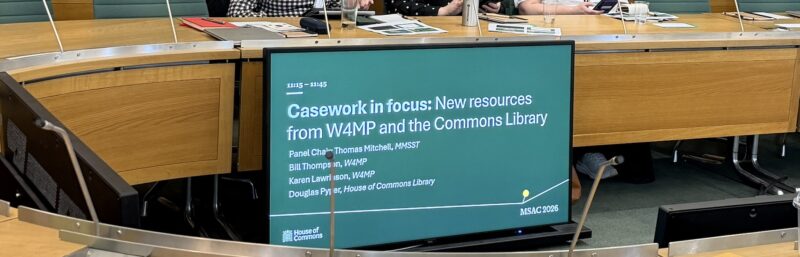
The House of Commons Library and w4mp have published two new guides to casework to help you and your office handle questions, casework and conversations with constituents.

Find out what MPs offices can and can’t help with, explore casework resources, get information for constituents and discover how to navigate the grey areas.

You can find the Library Guide on their website, with further resources on Parlinet including a link to the w4mp guide.

POLITICO PRO UK: Parliamentary access

Standard

POLITICO offers in-depth briefings and alerts from the corridors of Parliament, Whitehall and beyond. All MPs and staffers are eligible to receive POLITICO Pro U.K. newsletters as part of the corporate license. Sign up here to start receiving:

  • U.K. Pro Energy & Climate
  • U.K. Pro Trade
  • U.K. Pro Technology
  • U.K. Pro Financial Services
  • The Ex Files (Everything Brexit related)

At no additional cost. Join hundreds of your colleagues who are already taking advantage of our exclusive intelligence. Sign up now.

esThe coverage provides:

  • Real-time alerts – Be the first to know about breaking policy developments, regulatory changes, amendments, consultations and political shifts, helping you to move quickly and confidently.
  • Regular briefings – Cut through the noise with concise round-ups summarising what’s happening, why it matters and what’s coming next, giving you clear, actionable insight.
  • Forward-looking intelligence – Stay ahead with insight on upcoming legislation, regulatory moves, political strategy and stakeholder activity – and what it means for Parliament.

Sign up today.

Parliament’s People Awards

Standard

We’re coming up to the announcement of the 2026 Parliament’s People Awards, which recognise the inspirational teams and individuals who have impressed and shown dedication and commitment to supporting a thriving parliamentary democracy.

Anybody working for the House of Commons, House of Lords, the Parliamentary Digital Service, or in a constituency office can nominate a colleague who they believe has gone above and beyond in their work to enable UK democracy, and this year’s shortlist of nominations has now been published.

Here at w4mp we are really pleased to see that our own Karen Lawrinson, the mainstay of this site, maintainer of the hotlist, and all-round wonderful colleague has been shortlisted for the Parliamentary In-House Individual of the Year award, not just for the amazing work she does here but for her many other contributions she makes. As the nomination says, “Karen’s work directly improves the resilience, effectiveness, and cohesion of parliamentary teams, enabling staff across the UK to perform their roles with confidence and efficiency.”

It’s Parliament Week

Standard

It’s Parliament Week – see https://www.ukparliamentweek.org/en/ – and lots of activities will be taking place across the country. Parliament Week (UKPW) is an annual event, spreading the word about what Parliament is, what it does and how you can get involved and featured over 10,000 activities last year.

You may have heard from people running events with invitations for local MPs to attend.

Dissolution Guidance Published

A view of Parliament from Gt Peter St
Standard

Dissolution is the official term for the end of a Parliament before a general election. When Parliament is dissolved every seat in the House of Commons becomes vacant. MPs immediately revert to being members of the general public and those who wish to become MPs again must stand for election as candidates.

The House has now published its revised dissolution guidance, which aims to help Members and Members’ staff understand the rules in place and the support available to them before, during and after the next election, including what to expect during the dissolution period.

You can find  the guidance on the new parliamentary intranet, ParliNet, and we have published our own page on w4mp to track the guidance.

Please note that the guides etc may be updated before the election and so you should refer to ParliNet and not any stored web pages or PDFs for the latest guidance.

Research participants sought

w4mp sticker
Standard

Are you a parliamentary worker who uses evidence-based information as part of your role? A new research project supported by the Chartered Institute of Public Relations is asking what sources of information you use and why. The aim of the work is to understand how evidence could be communicated to policy makers more effectively. Take part in a short online survey and you could win £100 for yourself or for charity. For more information and to take part, go to this link:

https://oxford.onlinesurveys.ac.uk/communicating-evidence-to-policy-makers-what-works-best

Background

The request to post came from Dr Caroline Wood at Oxford University, who has been awarded a grant from the Chartered Institute of Public Relations (CIPR) to investigate which sources of information policy makers most rely on to access current evidence on topical issues.

The aim is that the findings of this will inform a publicly-accessible ‘best practice guide’ for all those whose role involves communicating evidence to policy makers (including thinktanks, research institutions, universities, and NGOs). By understanding which information sources are favoured by policy makers, this will allow organisations with limited resources for policy engagement to focus on the channels that are most likely to be effective.

The core activity of the project is a short online survey which asks policy makers (including policy advisers and research assistants for MPs) which sources of evidence they use and why.

They are looking for as many participants as possible in order to generate enough data to glean some valuable insights and we are happy to bring it to the attention of our readers

Call for 22/23 Balfour Project Fellowships

Standard

The Balfour Project intends to appoint fifteen Balfour Project Peace Advocacy Fellows for the academic year 2022-23. If you are a postgraduate or final year undergraduate student with an interest in Israel-Palestine, you are welcome to apply.

The selected fellows will be paid a bursary of £700 payable in two tranches at the midpoint and end of the academic year.

As a fellow, you will be given the opportunity to make a tangible contribution to the work of the Balfour Project by campaigning for peace within your academic institution and more generally,

Applications for the 2022/23 Fellowship are now open.

To find out more about the content and expectations for the 2022/23 Fellowship programme, please read our Call for Fellows.

If you would like to make an application, please click here to fill out and submit an application form. 

Applications for the 2022/23 Fellowship close on Friday 16th September 5 pm UK time. After which, the Fellowship coordination team will review applications and be in touch.

Please contact fellowship@balfourproject.org should you have any questions.

Research Fellowships with Good Things Foundation

Good Things Foundation home page
Standard

Good Things Foundation and Nominet have announced a new research scheme to help end data poverty and reduce the cost of living. The three research fellowships – part of the pioneering Data Poverty Lab – will each provide £12,000 funding to enable people to explore interventions with the aim of designing effective solutions to tackle data poverty.

With recent Ofcom figures showing 84% of benefits recipients unaware that they already qualify for cheaper broadband deals, the scheme is designed to both amplify existing interventions and highlight new ideas.

The Fellowships will explore three key themes which emerged from the Data Poverty Lab’s initial research:

  1. What community-led solutions to data poverty are emerging, and how could these be scaled regionally or nationally?
  2. How do we talk about data and data poverty? 
  3. Should internet access be viewed as an essential utility, a human right, or something else?

Individuals interested in applying for a Data Poverty Lab Fellowship should visit www.goodthingsfoundation.org/data-poverty-lab/fellowship/ or contact our Policy and Research Officer, Tom McGrath, by emailing tom.mcgrath@goodthingsfoundation.org. Applications are open from 23 February to 20 March 2022.

Call for Balfour Project Peace Advocacy Fellows 2021-22

Standard

READ HERE for the full call for fellows.

https://balfourproject.org/bp/wp-content/uploads/2021/09/Call-for-Balfour-Project.pdf

The Balfour Project intends to appoint up to twenty Peace Advocacy Fellows for the academic
year 2021-22. If you are a post-graduate or final year undergraduate student with an interest in the the IsraeliPalestinian conflict, you are welcome to apply.


The selected fellows will be paid a bursary of £700 payable in two tranches at the midpoint and end of theacademic year.

Theyh are open for applications between 1 September and 5pm of Friday, 29 October. Interviews will take place in the second half of October, and the fellows will be appointed at the end of the month.

http://www.balfourproject.org